Best Technology

Precision Cleaning, Passivation & Finishing Systems

Call Us612.392.2414
Contact an Expert
  • Equipment
    • Industrial Parts Washers
    • Ultrasonic Cleaning Systems
    • Vapor Degreasing Systems
    • Passivation Equipment
    • Electropolishing Equipment
    • Chem Film Equipment
    • Titanium Anodizing Systems
    • Mass Finishing Machines
    • Automation Systems
    • Wet Benches
    • Specialty & Custom Industrial Process Systems
  • Chemicals
    • Chemicals, Solvents & Fluids
    • BestSolv® Engineered Fluids
    • 3M™ Novec™ Replacement Fluids
    • 3M™ Novec™ Engineered Fluids, Chemicals, & Solvents
    • 3M™ Novec™ HFE Engineered Fluids and PFAS Phase Out
  • Industries
  • Articles
    • FAQ – Frequently Asked Questions
    • Ultrasonic Cleaning
      • How Do Ultrasonic Cleaners Work?
    • Passivation
      • What is Passivation?
    • Electropolishing
      • What is Electropolishing?
    • Surface Finishing
      • What is Alodine® / Chem Film / Chromate Conversion Coating?
      • What is Titanium Anodizing?
    • Industrial Parts Washers
    • Automation Systems
  • Case Studies
    • Industry Applications
    • Industrial Parts Washer Case Studies
    • Passivation Systems Case Studies
    • Part Cleaning Case Studies
    • Part Finishing Equipment Case Studies
    • Ultrasonic Cleaning Systems Case Studies
  • Testimonials
  • About Us
  • Contact Us
  • Equipment
    • Industrial Parts Washers
      • Products
        • Agitated Immersion Heated Parts Washer
        • Automatic Parts Washer System with Conveyor
        • Phosphating Lines
        • Automated Phosphate Lines for High-Volume Powder Coat Pre-Treatment
        • Oil Removal Systems
      • Case Studies
        • Pipe Washing Equipment
        • Designing a Phosphate Line for Today’s Process and Tomorrow’s Needs
        • Machine Shop Parts Washer for True Oil
        • Automotive Parts Washer System
    • Ultrasonic Cleaning Systems
      • Product Information
        • How Clean is Clean?
        • How Do Ultrasonic Cleaners Work?
        • What is an Azeotrope?
      • Products
        • Benchtop Ultrasonic Cleaner
        • Benchtop Ultrasonic Parts Cleaning Multi-Tank Systems
        • Ultrasonic Cleaning Consoles
        • Automated Ultrasonic Parts Cleaning Equipment Wash-Rinse-Dry
        • Automated Ultrasonic Cleaning System for High-Volume Production
        • Large Ultrasonic Parts Cleaner with Agitated Immersion
        • Immersible Ultrasonic Transducers
      • Case Studies
        • Automated Pickling and Cleaning System Case Study
        • Automated Ultrasonic Injection Mold Cleaner System
        • 3D Printer / FDM Parts Post Process Ultrasonic Cleaning
        • Machine Shop Parts Washer for Swiss and CNC Precision Parts
    • Vapor Degreasing Systems
      • Product Information
        • What Is Vapor Degreasing?
      • Products
        • Vapor Degreasing Systems
        • Vapor Degreasing Equipment and Ultrasonic Vapor Degreasers
      • Case Studies
        • Vapor Degreaser For Medical Device Instruments
    • Passivation Equipment
      • Product Information
        • What is Passivation? How Does It Work?
        • Nitric vs. Citric Acid Passivation
        • Passivation with Citric Acid
        • What Is Pickling of Stainless Steel? How Do Descaling, Pickling and Etching Work?
        • Passivation Cost Savings Calculator
      • Products
        • Benchtop Ultrasonic Passivation Equipment
        • Passivation Wet Bench for Citric / Nitric Acid
        • Ultrasonic Automated Passivation Equipment
        • Automated Passivation Systems for High-Volume Production
        • Agitated Immersion Multi-Tank Passivation Systems
        • Salt Fog and Humidity Test Chambers for Reliable Corrosion and Environmental Testing
      • Case Studies
        • Case Study: Bringing Citric Acid Passivation In-House for Stainless Steel Medical Device Parts
        • Automated Ultrasonic Passivation System for Medical Device Parts
        • Cleanroom Space Saving Automated Passivation System
        • Heated Polypropylene Acid Passivation and Rinse Tanks
        • Applicable Articles
    • Electropolishing Equipment
      • Product Information
        • What is Electropolishing? How Does Electropolishing Work?
        • Electropolishing Cycle and Current Calculator
        • Passivation vs. Electropolishing
      • Products
        • Tabletop Electropolishing Equipment & Electropolishing Machines
        • Electropolishing Wet Benches
        • Semi-Automated Electropolishing Systems for High-Volume Production
        • Large Scale Part Electropolishing Systems
      • Case Studies
        • EP System – Open Top Wet Bench with Spray Rinse
    • Surface Finishing Systems
      • Chem Film Equipment / Alodine Lines
        • Chem Film Equipment
        • What is Alodine / Chem Film / Chromate Conversion Coating?
        • Alodine Chem Film Tank Line
        • Ready to Set Up a Chem Film (Alodine) Line?
        • Automated Chem Film (Alodine) Systems
        • Hex Chrome Phase Out and Alternatives for Conversion Coating
        • Salt Fog and Humidity Test Chambers for Reliable Corrosion and Environmental Testing
      • Mass Finishing Machines
        • Centrifugal Barrel Finishing Machines
        • Vibratory Bowl Polishers
      • Titanium Anodizing
        • Titanium Anodizing Systems
        • What is Titanium Anodizing?
        • Titanium Anodizing Equipment
    • Automation Systems
      • Product Information
        • What Is Process Automation for Metal Finishing?
      • Products
        • Rail-Mounted Gantry Crane Automation
        • Automated Passivation Systems for High-Volume Production
        • Automated Ultrasonic Cleaning System for High-Volume Production
        • Automated Chem Film (Alodine) Systems
        • Semi-Automated Electropolishing Systems for High-Volume Production
        • Automated Phosphate Lines for High-Volume Powder Coat Pre-Treatment
        • Ultrasonic Automated Passivation Equipment
      • Case Studies
        • Automated Pickling and Cleaning System Case Study
        • Automated Passivation for High-Volume Production: Case Study
    • Wet Benches
      • Product Information
        • What is a Fume Hood? How Do Fume Hoods Work?
      • Products
        • Fume Hoods
        • Wet Bench for Semiconductor & FM4910 Applications
        • Wet Benches for Citric / Nitric Passivation of Stainless Steel and Titanium
        • Wet Benches for Electropolishing
        • Cascade Overflow Rinse Tanks
        • Quick Dump Rinse Tank
      • Case Studies
        • Semiconductor Chemical Processing Wet Bench and Fume Hood
    • Specialty & Custom Industrial Process Systems
      • Automated Chemical Neutralization Tank Cart
      • Salt Fog and Humidity Test Chambers
      • Vapor and Dryfilm PTFE Coating Systems
      • Heated Hot Air Parts Dryer
      • Solvent Recovery Equipment
    • Process Validation Templates
    • Equipment Financing
  • Chemicals, Solvents & Fluids
    • Chemicals, Solvents & Fluids from Best Technology
    • BestSolv® Engineered Fluids
    • Solvent Cleaning Fluids
      • Solvent Cleaning with BestSolv® Engineered Fluids
      • BestSolv® Alpha
      • BestSolv® Bravo
      • BestSolv® Delta
      • BestSolv® Echo
      • BestSolv® Lima
      • BestSolv® Omega: PFAS Free
      • BestSolv® Omega Plus: PFAS-Free
      • BestSolv® Sierra
      • BestSolv® Theta
      • BestSolv® Zeta: PFAS-Free
      • BestSolv® 5408: Boeing Spec BAC 5408 Qualified Cleaning Solvent
      • BestSolv® 7100
      • BestSolv® 7200
      • BestSolv® 7300
      • BestSolv® 71DE
      • BestSolv® 72DA
      • BestSolv® 72DE
      • BestSolv® 73DE
      • BestSolv® nPB: TCE Replacement
      • Latent Fingerprint Processing with BestSolv® Engineered Fluids
      • What Are Hydrofluoroether (HFE) Fluids?
      • Film Cleaning with BestSolv® 7200
      • Oxygen System and Oxygen Gauge Cleaning Solutions
      • Engineered Fluids for Fluid Simulation and Aerospace Vibration Testing
      • Carrier Fluids for Precision Deposition, Wetting, and Material Transport
      • Choosing the Best Vapor Degreaser Solvent
    • Thermal Management / Heat Transfer Fluids
      • Thermal Management / Heat Transfer with BestSolv® Engineered Fluids
      • BestSolv® Zulu Immersion Cooling Fluid
      • BestSolv® Zulu MAG Magnesium Protection Fluid
      • BestSolv® Zulu FS Fire Suppression Fluid
      • BestSolv® 7100
      • BestSolv® 7200
      • BestSolv® 7300
      • BestSolv® 3283
      • BestSolv® 40
      • BestSolv® Fluids as Coolants for Specialized Machinery and Chiller Systems
      • Magnesium Cover Gas, Re-Engineered for Today
      • Gross Leak Testing for Hermetic Components and Critical Assemblies
    • PFAS-Free Next Generation
      • BestSolv® Omega: PFAS-Free
      • BestSolv® Omega Plus: PFAS-Free
      • BestSolv® Zeta: PFAS-Free
      • PFAS-Free Cleaning Solvents for Vapor Degreasing Applications
      • BestSolv® HFO / HCFO Solvents for Precision Cleaning
    • 3M™ Novec™ Replacements
      • 3M™ Novec™ Replacement Fluids
      • 3M™ Novec™ 7100 Replacements
      • 3M™ Novec™ 7200 Replacement
      • 3M™ Novec™ 7300 Replacement
      • 3M™ Novec™ 71DA Replacements
      • 3M™ Novec™ 71DE Replacement Options
      • 3M™ Novec™ 71IPA Replacements
      • 3M™ Novec™ 72DA Replacements
      • 3M™ Novec™ 72DE Replacements
      • 3M™ Novec™ 73DE Replacement
      • Running Out of 3M™ Novec™ Stock? How to Transition to Your BestSolv® Replacement Path
    • 3M™ Novec™ Engineered Fluids and Fluorinert™ Liquids
      • 3M™ Novec™ Engineered Fluids
      • 3M™ Novec™ HFE Engineered Fluids and PFAS Phase Out
      • 3M™ Novec™ Cleaning Solvents
        • Solvent Cleaning with 3M™ Novec™ Engineered Fluids
        • 3M™ Novec™ 7100
        • 3M™ Novec™ 7200
        • 3M™ Novec™ 7300
        • 3M™ Novec™ 71DA
        • 3M™ Novec™ 71DE
        • 3M™ Novec™ 71IPA
        • 3M™ Novec™ 72DA
        • 3M™ Novec™ 72DE
        • 3M™ Novec™ 73DE
      • 3M™ Fluorinert™ and 3M™ Novec™ Heat Transfer and Thermal Management Fluids
        • 3M™ Fluorinert™ Electronic Liquids for Thermal Management / Heat Transfer
        • 3M™ Novec™ 649
        • 3M™ Novec™ 7100
        • 3M™ Novec™ 7200
        • 3M™ Novec™ 7300
    • Solvent Phase Outs
      • 3M™ Novec™ HFE Engineered Fluids and PFAS Phase Out
      • nPB Replacement
      • TCE Replacement
      • Methylene Chloride Replacement
    • Aqueous Cleaning
      • Aqueous Cleaning Solutions: Alkaline Cleaners
      • How Clean is Clean?
    • Surface Finishing Chemicals
      • CitriSurf Passivation Chemistry for Citric Acid Passivation
      • Electropolishing Solutions: Electrolyte Chemicals
      • Conversion Coating Chemistry
      • Hex Chrome Phase Out and Alternatives for Conversion Coating
  • Industries
  • Customer Testimonials
  • About Us
  • Contact Us
Contact an Expert
home Best Technology / Passivation Equipment & Ultrasonic Passivation Systems for Stainless Steel with Nitric / Citric Acid / Automated Passivation Systems for High-Volume Production

Automated Passivation Systems for High-Volume Production

  • System Description
  • Common Applications
  • Common Configurations

Heavy-Duty Passivation System

For passivation systems where high-volume production processing is a requirement, Best Technology is pleased to offer Automated Passivation Systems for High-Volume Production.

Our innovative gantry rail system, distinct from traditional overhead systems, integrates seamlessly with the tank line. This design saves valuable production floor space while enhancing operational efficiency and productivity.

Video: Rail-Mounted Automation Boosts Passivation Output
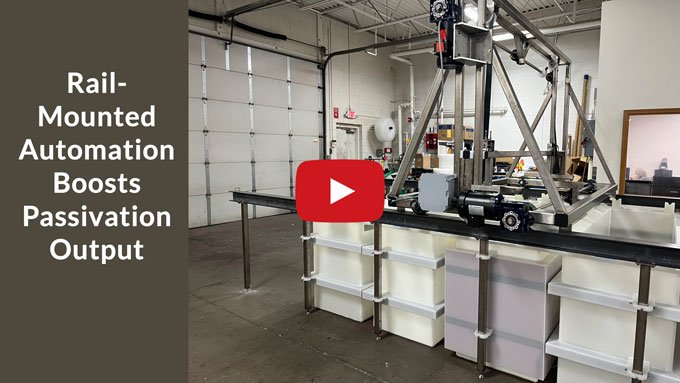
Rail Mounted Gantry Automation Boosts Passivation Output

Automated Passivation System for High-Volume Production

Built with large-volume polypropylene tanks and fume-resistant components, including robust 304 stainless steel framing and a fiberglass I-beam, our system stands resilient against harsh chemicals, assuring superior chemical durability and equipment longevity.

By anchoring the automation’s structural supports directly to the tanks, we deliver a stable and efficient operation that ensures your production line is always ready to perform at its best. This integrated design enables the system to monitor readiness by checking that fluid temperatures are met, and the line is prepared to start receiving components into the passivation system for processing.

“The automated passivation system for high-volume production combines proven passivation chemistry with advanced automation for basket movement, solution transfer, and process control. The result is a fully integrated, closed-loop system that maximizes uptime and repeatability while maintaining compliance with ASTM A967 and AMS 2700.”

— Products Finishing Online

What Is an Automated Passivation System?

An automated passivation system for high-volume production combines a multi-stage passivation line with programmable material handling. Instead of requiring an operator to manually move baskets or racks from tank to tank, a rail-mounted gantry system can move loads through the required process stages according to programmed recipes.

A typical citric acid passivation sequence may include:

  1. Alkaline cleaning
  2. Water rinsing
  3. Citric acid passivation
  4. One or more final rinses
  5. Drying
  6. Inspection or testing as required by the applicable specification

The exact sequence depends on the alloy, part condition, process specification, production requirements, and other surface treatments involved.

Rail-Mounted Gantry Automated Passivation System
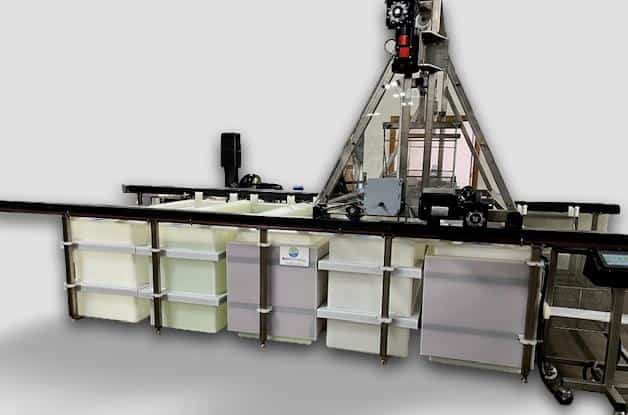
automated passivation system

Automated Passivation System Features

Experience enhanced productivity and safety with our Automated Passivation Systems:

  • Integrated Automation: Our system eliminates the need for cumbersome overhead cranes, offering seamless operation and control through a single PLC controller. This integration ensures your system is always primed for action, maximizing efficiency. With a single point of access, the PLC controller enhances operational safety by reducing complexity and ensuring precise system control.
  • Customizable Load Capacity: With a standard capacity of up to 300 lbs. per load and the option for customization up to 1000 lbs., our system adapts to your specific project needs, accommodating a variety of load sizes and applications.
  • Flexible Operation Modes: Choose between fully automated and manual modes to suit your production requirements.
    • Fully Automated: In fully automated mode, the system follows pre-programmed recipes, moving baskets or racks through the process according to specified times and conditions. This mode is ideal for consistent, high-volume production.
    • Manual: In manual mode, an operator can manually control the movement of baskets or racks using a joystick, allowing for more hands-on management of the process. This mode is beneficial when specific adjustments are needed during production.
  • Advanced Safety Features: Prioritize safety with features like e-stop cords, hard stops on I-beams, and pinch guards. Safety light curtains are also available as an option. Low-level sensors in the tanks ensure that equipment does not run without adequate liquid level. These elements create a secure working environment, protecting your operators and ensuring peace of mind.
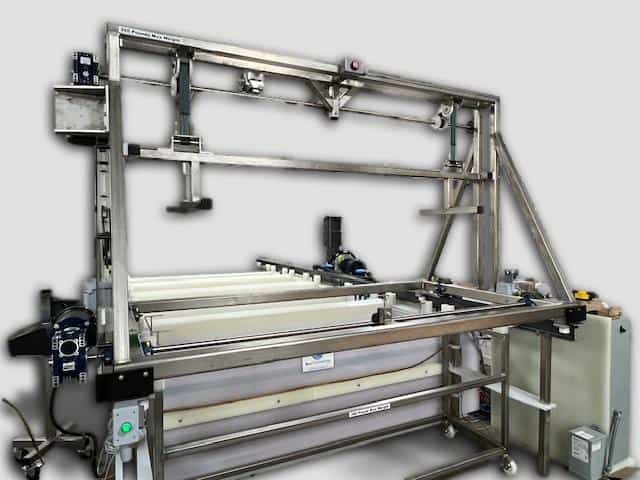
automated passivation gantry crane
  • Multiple Load Processing: Our compact gantry rail system processes multiple loads simultaneously, optimizing throughput and reducing space requirements compared to traditional systems. While one load is passivating, another load can be cleaned and dried, skipping over the passivation in progress. This allows for greater throughput and higher production volumes.
  • Flowlines: Larger diameter pipes allow for faster filling of tanks, increasing efficiency. Rinse tanks can be connected to an RO (reverse osmosis) or DI (deionized) water source, such as a DI skid.
  • Automated Tank Filling: The automation system uses flow restrictors and solenoid valves to automatically control the filling process, eliminating the need for manual tank filling by the operator.
  • Advanced Monitoring: The conductivity meter in the final rinse ensures that rinse water remains fresh, and automatically triggers the addition of more water when needed. Similarly, the pH meter in the passivation tank monitors the passivation solution and triggers the addition of more passivation solution as needed.
  • Flowing Rinses: Rinse tanks use an overflow weir when adding water, so the water at the top of the tank is emptied first, while new fresh water enters from below. This essential feature helps maintain the freshness of the rinse water after each rinse.
  • Efficient Drying: Air knife drying tank uses a regenerative blower with warm air for high amounts of air at low pressures, for clean, contaminant-free drying.
  • Chemical Compatibility: Built tough with fume-resistant components, our system withstands harsh chemicals, ensuring long-term durability and reliability in demanding environments.
  • Load and Unload Carts: Streamline your workflow with wheeled load and unload carts, facilitating easy handling of baskets or racks. Extra carts are available for staging, ensuring continuous operation. Operators are not required to lift any items, minimizing physical strain and enhancing overall efficiency.
  • Single-Button Start: The operator can start the next load by simply moving the next cart into the loading position and pressing a single button once the PLC is programmed.
  • Racks or Baskets: Tailor the system to your needs with options for racks or baskets, providing flexibility based on part requirements. Racks prevent contact between parts, while baskets allow for bulk processing.

These features make Best Technology’s Automated Passivation Systems a robust solution for high-volume production, delivering efficiency, safety, and reliability.

Learn more about automation benefits on our page What is Process Automation for Metal Finishing?

How Rail-Mounted Gantry Automation Works

Best Technology’s rail-mounted gantry crane automation is installed directly along the process tank line rather than relying on a traditional overhead bridge crane.

The gantry travels horizontally along rails mounted to the system and raises or lowers baskets and racks into the required processing tanks. A single PLC can control both the chemical process equipment and material handling system, allowing operators to manage the line through one control architecture.

Programmable recipes allow manufacturers to process different part families or process requirements without relying on operators to manually track every tank sequence and dwell time.

Why Automate Citric Acid Passivation?

Citric acid passivation depends on controlled process conditions. Depending on the applicable method, factors such as chemistry concentration, temperature, and immersion time must be maintained within the required process parameters. Standards such as ASTM A967 and AMS 2700 include citric acid passivation methods with defined process requirements.

Automation helps control the equipment side of that process.

A programmable logic controller, or PLC, can manage recipes that define how loads move through the line and how long they remain in each stage. The gantry then moves baskets or racks between tanks according to those programmed instructions. This can reduce variation caused by manual part handling while making it easier to repeat the same process sequence from one load to the next.

For manufacturers processing many loads each day, that repeatability can become increasingly important.

From Cleaning Through Final Rinse

Automation does not change the basic purpose of citric acid passivation. The parts still need to arrive at the passivation stage with the surface properly prepared.

The process typically begins with cleaning to remove oils, contaminants, and foreign material from the stainless steel surface. The parts are then rinsed before entering the citric acid bath. Following passivation, additional rinsing removes residual process chemistry before the parts are dried.

In an automated system, the gantry handles movement between those stages while the tanks themselves provide the required cleaning, rinsing, passivation, and drying functions.

That distinction is important. Automation supports the process, but it does not replace the need to design the chemistry, tanks, temperatures, rinse quality, and dwell times correctly.

Automated Passivation System with Basket
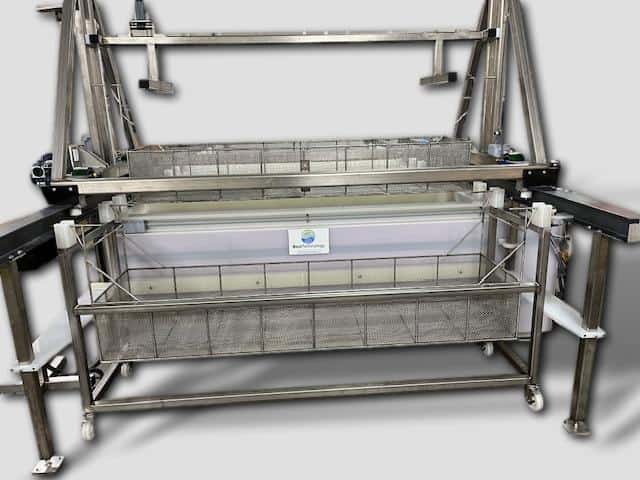
automated passivation system basket

Automated Passivation FAQs

  • Why are automated systems easier to process validate than manual equipment?
    Process control and stability are critical aspects to regulated medical device and aerospace processes.  It is important to ensure that a process has input and output variable limits which are defined and fully tested during process design, Equipment Qualification (IQ), Operational Qualification (OQ) and Process Qualification (PQ) validation testing.  Setting up a proper DOE (Design of experiments) to test these limits is also important as the results of the DOE will give statistical confidence intervals of the limits. Being that operators and employees perform various process operations different no matter how instructed in work instructions, the variation of operators must also be captured during process qualification (PQ) validation.  An automated system typically eliminates many of the operator variability in the manufacturing process and this process “input” elimination also allows for tighter process output controls. For example, in our automated passivation system, the elimination of relying on an operator to move the parts basket from stage to stage ensures that the parts remain in the appropriate (wash, rinse, acid passivation, etc) solutions for the process defined times and in accordance with the proper ASTM A967, AMS2700, etc specification.  If a parts basket is immersed in the acid passivation solution too short or long duration, the passivation can likely fail and be outside specification limits.
  • Do you need any agitation beyond ultrasonics during the cleaning or passivation process with an automated system?

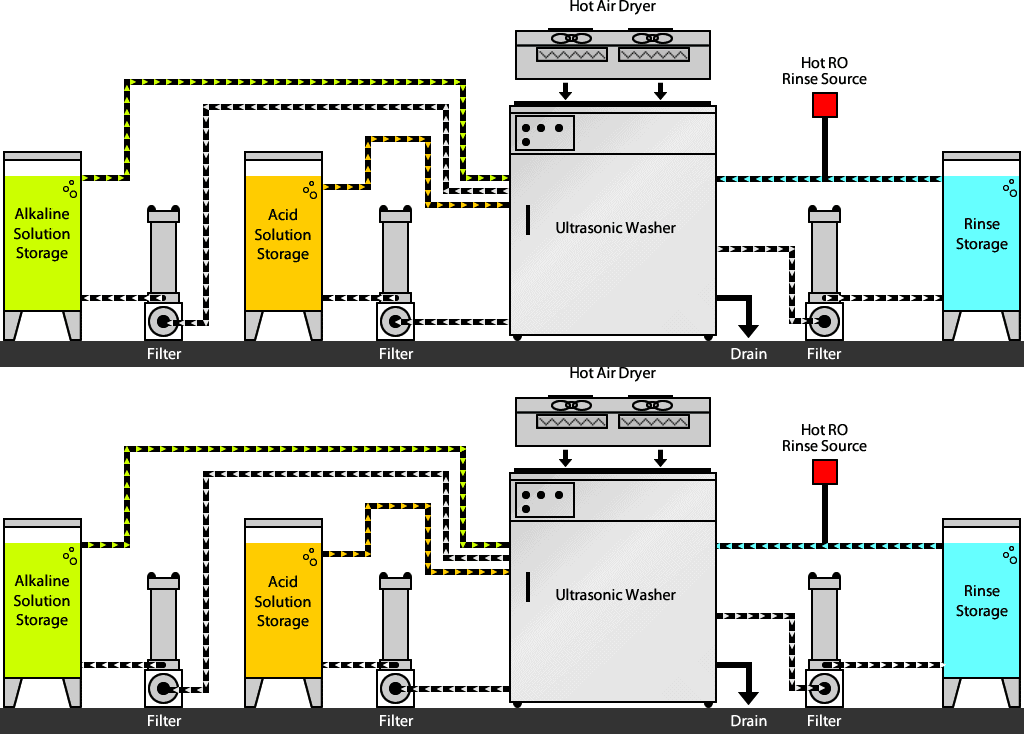
    Our automated cleaning and passivation system includes in-process tank circulation which agitates the solution, alternating between ultrasonics (as fluid movement dissipates ultrasonic energy). This also allows the process tank to filter solution back in the storage tank.

    ultrasonic-cleaning-passivation-animation

  • In an automated system, are there contamination issues when you pump solutions out of the main processing tank?

    Many of our automated cleaning and passivation systems pump the cleaning, rinsing and passivation acid solutions between tanks, unlike a traditional system where the parts are moved from tank to tank.

    ultrasonic-cleaning-passivation-animation

    To reduce any contamination issues, we mount rinse spray nozzles in the cover of the system to rinse down the parts and tank walls. All the plumbing to and from the process tanks is separated to further reduce any contamination. This results in less contamination compared to the drag-out that occurs from moving parts from tank-to-tank in a traditional multi-tank setup.

  • What is the industry standard for acceptable particle count after cleaning or passivation?

    Acceptable particle counts depend on the specification which the parts are processed to: ASTM A967, A380, F86, AMS 2700, etc. For passivation, DI rinse water is recommended for best results.

    Our automated systems offer conductivity meters which monitor water quality and total dissolved solids.  The storage tanks have facility DI water source needle valves which open when conductivity limits are not met. This allows for a continual overflow of the rinse tank until rinse water specifications are reached.

  • What are the pros and cons of ultrasonic automated systems vs. rail-mounted gantry crane automation?

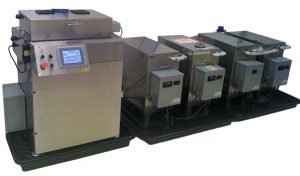
    Ultrasonic Automated System

    Moves the fluids, not the parts.

    Ultrasonic Automated Passivation EquipmentPros:

    • Lower System Cost: Typically less expensive to purchase and install.

    • Simplified Maintenance: Fewer moving parts reduce the risk of mechanical failure and simplify upkeep.

    • Compact Footprint: Takes up less space on the production floor.

    • Flexible Tank Placement: Storage tanks can be located outside of the cleanroom or processing area.

    • Closed-Loop Operation: Minimizes operator exposure to chemicals, improving safety and compliance.

    Cons:

    • Longer Cycle Times: Requires time to fill and drain the process chamber (typically ~2 minutes each).

    • Single-Basket Workflow: You must wait for the entire cycle to finish before processing the next batch.

    • Process Limitations: Not compatible with pickling or descaling applications.


    Rail-Mounted Gantry Crane Automation

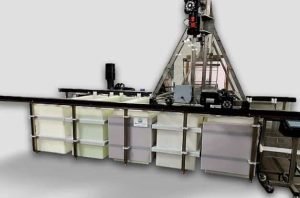
    Baskets of parts are moved automatically through a series of tanks.

    automated passivation system with rail-mounted gantry cranePros:

    • Higher Throughput: Multiple baskets can be processed in succession, increasing production capacity.

    • Scalable Design: Systems can be built much larger to handle high-volume needs.

    • Supports Pickling/Descaling: Capable of handling aggressive chemical processes.

    • Faster Cycles: No fill or drain steps—parts move through already-filled process tanks.

    Cons:

    • Higher Initial Cost: Requires more infrastructure and automation.

    • Larger Footprint: Occupies more floor space compared to pump-based systems.

    • Increased Maintenance: More mechanical components introduce additional maintenance needs.

No questions matching current filter

Common Applications for Automated Passivation Systems

Our Automated Passivation Equipment excels in industries demanding high-volume production with stringent quality standards. Ideal for aerospace, medical devices, and electronics sectors, our systems ensure precision and reliability. With the ability to handle various load sizes and applications, they offer a versatile solution for diverse industrial needs.

Our automated passivation system is specifically engineered for high-volume stainless steel passivation in compliance with industry standards such as ASTM A967, AMS 2700 and ASTM F86. It supports the following methods:

  • Nitric acid passivation type 1, 2, 3, 4 (including methods using sodium dichromate)
  • Citric acid passivation type 1, 2, 3, 4 & 5 using CitriSurf®, or other citric acid solutions such as Esma E964 Citric Deox

CitriSurf® is a registered trademark of Stellar Solutions, Inc. McHenry IL USA.

Other Applications

Best Technology’s automated systems are not only ideal for high-volume production with passivation, but also perfectly suited for a wide range of other chemical processing applications.

  • Chem Film / Alodine / Chromate Conversion Coating
  • Electropolishing
  • Ultrasonic Cleaning / Precision Cleaning
  • Phosphate Coating
  • Pickling, Descaling and Etching

Citric Acid vs. Nitric Acid Passivation

Citric acid and nitric acid can both be used to passivate stainless steel, and both are recognized within common industry standards. Citric acid has increasingly been adopted because it can offer safety and environmental advantages compared with nitric acid.

The correct chemistry still depends on the material, customer requirements, applicable specification, and required process.

For a more detailed comparison, see Best Technology’s Nitric vs. Citric Acid Passivation resource.

ConsiderationCitric Acid PassivationNitric Acid Passivation
Common standardsASTM A967 and AMS 2700ASTM A967 and AMS 2700
General purposeStainless steel passivationStainless steel passivation
Safety/environmental profileGenerally safer and more environmentally friendlyRequires greater handling and environmental controls
Equipment automationCan be automatedCan be automated

Citric Acid Passivation and Industry Standards

Citric acid passivation is addressed by widely used standards including ASTM A967 and AMS 2700. Both standards include citric acid immersion treatments, although the specific requirements vary by method.

For manufacturers working in regulated or specification-driven industries, repeatability becomes particularly important. Automation can help ensure that the equipment consistently follows the programmed processing sequence, but the manufacturer remains responsible for establishing and validating the process required by the applicable specification.

Best Technology designs passivation equipment for stainless steel around customer-specific applications, including chemistry, tank configuration, automation level, part geometry, throughput, and validation requirements.

When Does Automation Make Sense?

Not every citric acid passivation process needs a rail-mounted gantry system.

For lower production volumes or smaller components, manual wet benches, benchtop systems, or automated ultrasonic systems may be a better fit. Best Technology offers multiple passivation system configurations because part size, throughput, chemistry, handling requirements, and validation needs vary significantly between applications.

Rail-mounted automation becomes especially relevant when manufacturers need to:

  • Process higher numbers of loads
  • Reduce manual basket or rack movement
  • Maintain repeatable tank sequences and dwell times
  • Handle heavier loads
  • Run multiple process recipes
  • Reduce operator interaction with chemical tanks
  • Integrate process controls and material handling into one system

The decision should start with the manufacturing process and production requirements, not simply with the desire to automate.

Common Configurations

Automated passivation systems for high-volume production offer great flexibility in sizing. Each system is custom-built to the requirements of your application. Tank size range can be from 50 gallons to hundreds of gallons, and is highly customizable.

Standard load capacity for baskets is 300 lbs., but can be higher based on project requirements. Racks and extra baskets are also available.

Designing the Automation Around the Passivation Process

Automation works best when it is treated as part of the process design rather than equipment added afterward.

The chemistry determines the required process conditions. The parts determine how they need to be held and moved. Production volume influences load size and cycle requirements. The applicable specification determines which conditions must be maintained and documented.

Those factors then determine the appropriate tanks, controls, racks or baskets, material handling, and automation strategy.

Best Technology works with manufacturers to develop automation systems for metal finishing around these application-specific requirements rather than forcing different processes into one standard system.

Excellence in High-Volume Automated Passivation Systems

Elevate your production efficiency with Best Technology’s Automated Passivation Systems. Contact a passivation expert today to discover how our customizable solutions can be tailored to meet your specific requirements and transform your manufacturing process.
Latest News & Products from Best Technology

Industrial vapor-only degreasing machine

Vapor Degreasing Equipment and Ultrasonic Vapor Degreasers

Industrial Precision Cleaning Solutions Best Technology supplies industrial vapor degreasing equipment for manufacturers requiring reliable, repeatable precision cleaning. Our vapor degreasers are configured around each customer's application, including part dimensions, contaminants, cleaning requirements, solvent selection, and production throughput. [joli-toc] We offer equipment solutions ranging from [...]

Read More

Read More

Trusted By Thousands of Customers Since 1992

  • Industrial Parts Washers
    • Products
      • Agitated Immersion Heated Parts Washer
      • Automatic Parts Washer System with Conveyor
      • Phosphating Lines
      • Automated Phosphate Lines for High-Volume Powder Coat Pre-Treatment
      • Oil Removal Systems
    • Case Studies
      • Pipe Washing Equipment
      • Designing a Phosphate Line for Today’s Process and Tomorrow’s Needs
      • Machine Shop Parts Washer for True Oil
      • Automotive Parts Washer System
  • Ultrasonic Cleaning Systems
    • Product Information
      • How Clean is Clean?
      • How Do Ultrasonic Cleaners Work?
      • What is an Azeotrope?
    • Products
      • Benchtop Ultrasonic Cleaner
      • Benchtop Ultrasonic Parts Cleaning Multi-Tank Systems
      • Ultrasonic Cleaning Consoles
      • Automated Ultrasonic Parts Cleaning Equipment Wash-Rinse-Dry
      • Automated Ultrasonic Cleaning System for High-Volume Production
      • Large Ultrasonic Parts Cleaner with Agitated Immersion
      • Immersible Ultrasonic Transducers
    • Case Studies
      • Automated Pickling and Cleaning System Case Study
      • Automated Ultrasonic Injection Mold Cleaner System
      • 3D Printer / FDM Parts Post Process Ultrasonic Cleaning
      • Machine Shop Parts Washer for Swiss and CNC Precision Parts
  • Vapor Degreasing Systems
    • Product Information
      • What Is Vapor Degreasing?
    • Products
      • Vapor Degreasing Systems
      • Vapor Degreasing Equipment and Ultrasonic Vapor Degreasers
    • Case Studies
      • Vapor Degreaser for Medical Device Instruments
  • Passivation Equipment
    • Product Information
      • What is Passivation? How Does It Work?
      • Nitric vs. Citric Acid Passivation
      • Passivation with Citric Acid
      • What Is Pickling of Stainless Steel? How Do Descaling, Pickling and Etching Work?
      • Passivation Cost Savings Calculator
    • Products
      • Benchtop Ultrasonic Passivation Equipment
      • Passivation Wet Bench for Citric / Nitric Acid
      • Ultrasonic Automated Passivation Equipment
      • Automated Passivation Systems for High-Volume Production
      • Agitated Immersion Multi-Tank Passivation Systems
      • Salt Fog and Humidity Test Chambers for Reliable Corrosion and Environmental Testing
    • Case Studies
      • Case Study: Bringing Citric Acid Passivation In-House for Stainless Steel Medical Device Parts
      • Automated Ultrasonic Passivation System for Medical Device Parts
      • Cleanroom Space Saving Automated Passivation System
      • Heated Polypropylene Passivation and Rinse Tanks
      • Applicable Articles
  • Electropolishing Equipment
    • Product Information
      • What is Electropolishing? How Does Electropolishing Work?
      • Electropolishing Cycle and Current Calculator
      • Passivation vs. Electropolishing
    • Products
      • Tabletop Electropolishing Equipment & Electropolishing Machines
      • Electropolishing Wet Benches
      • Semi-Automated Electropolishing Systems for High-Volume Production
      • Large Scale Part Electropolishing Systems
    • Case Studies
      • EP System – Open Top Wet Bench with Spray Rinse
  • Surface Finishing Systems
    • Alodine Lines
      • Chem Film Equipment for Chromate Conversion Coating
      • What is Alodine® / Chem Film / Chromate Conversion Coating?
      • Alodine Chem Film Tank Line
      • Ready to Set Up a Chem Film (Alodine) Line?
      • Automated Chem Film (Alodine) Systems
      • Hex Chrome Phase Out and Alternatives for Conversion Coating
      • Salt Fog and Humidity Test Chambers for Reliable Corrosion and Environmental Testing
    • Mass Finishing Machines
      • Centrifugal Barrel Finishing Machines
      • Vibratory Bowl Polishers
    • Titanium Anodizing
      • Titanium Anodizing Systems
      • What is Titanium Anodizing?
      • Titanium Anodizing Equipment
  • Automation Systems
    • Product Information
      • What Is Process Automation for Metal Finishing?
    • Products
      • Rail-Mounted Gantry Crane Automation
      • Automated Passivation Systems for High-Volume Production
      • Automated Chem Film (Alodine) Systems
      • Semi-Automated Electropolishing Systems for High-Volume Production
      • Automated Ultrasonic Cleaning System for High-Volume Production
      • Automated Phosphate Lines for High-Volume Powder Coat Pre-Treatment
      • Ultrasonic Automated Passivation Equipment
    • Case Studies
      • Automated Passivation for High-Volume Production: Case Study
      • Automated Pickling and Cleaning System Case Study
  • Wet Benches
    • Product Information
      • What is a Fume Hood? How Do Fume Hoods Work?
    • Products
      • Fume Hoods
      • Wet Benches for Semiconductor & FM4910 Applications
      • Wet Benches for Citric / Nitric Passivation of Stainless Steel and Titanium
      • Wet Benches for Electropolishing
      • Cascade Overflow Rinse Tanks
      • Quick Dump Rinse Tank
    • Case Studies
      • Semiconductor Chemical Processing Wet Bench and Fume Hood
  • Specialty & Custom Industrial Process Systems
    • Products
      • Automated Chemical Neutralization Tank Cart
      • Salt Fog and Humidity Test Chambers
      • Vapor and Dryfilm PTFE Coating Systems
      • Heated Hot Air Parts Dryer
      • Solvent Recovery Equipment
  • Chemicals, Solvents & Fluids
    • Precision Cleaning Solvents
      • BestSolv® Engineered Fluids
      • Solvent Cleaning with BestSolv® Engineered Fluids
      • 3M™ Novec™ Replacement Fluids
    • Aqueous Cleaning
      • Aqueous Cleaning Solutions: Alkaline Cleaners
    • Surface Finishing Chemicals
      • CitriSurf Passivation Chemistry for Citric Acid Passivation
      • Electropolishing Solutions: Electrolyte Chemicals
      • Conversion Coating Chemistry
  • Process Validation Templates
  • Equipment Financing
Best Technology applications engineer

Connect with Our
Experts Today!

Ready to boost your manufacturing process efficiency?

Our expert team is just a click away. Reach out now to get personalized advice on choosing the best system for your specific needs. Let's enhance your operations together!

Contact an Expert
Best Technology Inc.

Best Technology Inc.
14040 23rd Avenue N.
Minneapolis, MN 55447

phone icon612.392.2414

Follow Us
  • Facebook icon
  • X icon
  • LinkedIn icon
  • YouTube icon
  • Pinterest icon

Quick Links

  • Product Line Card
  • Case Studies
  • Videos
  • Site Map
  • Equipment Financing
  • Contact Us

Products

  • Industrial Parts Washers
  • Ultrasonic Cleaning Systems
  • Passivation Equipment
  • Electropolishing Equipment
  • Surface Finishing Systems
  • Chemistries, Solvents & Fluids

Industries Served

  • Medical Device
  • Aerospace
  • Electronics
  • Automotive
Contact an Expert

Copyright © 2026 · Best Technology Inc. · Privacy Policy

Precision Cleaning, Passivation & Finishing Systems
Contact an Expert
612.392.2414
  • facebook
  • Twitter
  • LinkedIn
  • YouTube
  • Pinterest

"*" indicates required fields

1Contact Info
2Your Project

Start Here for the Best Solution

Are you looking to purchase equipment?*
Note: We specialize in custom metal finishing equipment and do not offer job shop or contract services.
Best Technology designs custom metal finishing equipment for commercial manufacturing environments. Hobby, student, or consumer projects are not supported.
Are you looking for budgetary pricing or a formal quote?
How soon are you looking to purchase equipment?
Has this project received internal approval at your organization?
Are you currently doing this process in-house or sending it out to a vendor?